Tag: IFSC

Firsts, Falls, and Fastest Runs: China Sweeps Gold at Guiyang Speed World Cup

Firsts, Falls, and Fastest Runs: China Sweeps Gold at Guiyang Speed World Cup

Lightning & Firsts: Guiyang Speed World Cup Delivers Golds, PBs, and Surprise Exits

China’s Guiyang stop of the IFSC Speed World Cup closed out the season with a volley of first-time winners, photo-finishes, and record-breaking heart. In front of a roaring home crowd, Chinese climbers stole both gold medals. But the story was far more than just home advantage—it was about razor-thin margins, mental grit, and unexpected exits.


Key Matches & Climbs

Women

  • Meng Shixue broke through in style. Her gold in Guiyang was her first ever World Cup medal, and it went to her in spectacular fashion on home soil with a time of 6.30 seconds, edging Jeong Jimin, who finished at 6.36 seconds.
  • Emma Hunt earned bronze after Zhou Yafei had a full fall in the bronze medal match—6.44 seconds was enough for Hunt to stand on the podium.
  • In the semifinals Meng had posted a personal best of 6.29 s over Hunt’s 6.35 s, setting up her gold-bout confidence. Jeong advanced past Zhou with 6.42 s vs 6.51 s.

Men

  • Chu Shouhong took gold with a personal best 4.79 seconds, beating Ryo Omasa (4.99) in the gold match.
  • Leander Carmanns grabbed bronze in a tight match, finishing at 4.98 seconds, just ahead of Yaroslav Tkach’s 5.11 in that bronze race.
  • Even earlier rounds were dramatic: Zach Hammer posted a sharp 4.959 s in the Round of 16. Tkach set a new European record in qualifications with 4.86 s. Ryo Omasa’s silver bumped him up to third in the overall speed standings.

Upsets, Slips & Storylines

  • Unexpected exits: Sam Watson (USA), the men’s world record holder, and Kiromal Katibin (Indonesia), the season leader, both went out in the Round of 16.
  • Slipping was epidemic. Nearly every round saw at least one athlete undone by a slip—especially in the early and middle sections. It made rhythm, reaction time, and composure more decisive than raw speed.
  • Firsts all around: For Meng, this was the breakthrough. Carmanns and Omasa solidified strong seasons by converting opportunities into podiums at just the right moment.

What It Means in the Big Picture

  • With his gold in Guiyang, Chu Shouhong clinches the men’s speed title in style.
  • On the women’s side, Emma Hunt secures the season title. Even though she wasn’t gold tonight, her consistency across events made her the overall champion.
  • Ryo Omasa’s silver lifts him into third in the overall season standings—he ends the year as part of a top-three that includes Katibin and Watson.
IFSC Koper Lead World Cup Recap: Home Golds, Heartbreak, and Season Crowns

IFSC Koper Lead World Cup Recap: Home Golds, Heartbreak, and Season Crowns

Men’s Recap

Setting the Stage

In Koper’s golden evening, the setters delivered a route as poetic as it was punishing—flowing with rhythm, decision moments, and momentum. It was climbing as cinema, every hold a scene.

Bright Liminals & Early Exits

The climb’s elegance made even a tiny slip feel seismic. Neo Suzuki’s right foot popped early, ending his final at 10+, a gut-punch exit from one of the favorites.
Putra Tri Ramadani quietly became another headline—Indonesia, known for speed climbing dominance, now showing real promise in lead. His first World Cup final was a breakthrough.

Olympic Glory vs World Cup Glory

All eyes were on Alberto Gines Lopez—an Olympic gold medalist yet still chasing his first World Cup win. He climbed to 47, sealing a medal and his best shot yet at that elusive gold. But Toby Roberts followed and fell at 46, cementing Gines Lopez’s silver.

Only One Japanese Climber Could Medal

Satone Yoshida sat nervously on the bubble of the podium with a score of 45, watching as his compatriot Sorato Anraku close the competition. Anraku delivered, reaching 48 to clinch gold—and leave Gines Lopez still chasing his first World Cup victory.

Men’s Podium – Koper Lead World Cup

RankClimberResult
1Sorato Anraku (JPN)48+
2Alberto Gines Lopez (ESP)47+
3Toby Roberts (GBR)46+

Women’s Recap

Slovenia’s Sisters Take the Stage

In the electric atmosphere of Koper, four Slovenian women earned tickets to the final—an emphatic home showcase of depth and talent. Janja Garnbret, in peak form, shared a perfect semi-final climb with South Korea’s Seo Chaehyun, setting up a heavyweight battle in front of Garnbret’s home crowd.

Early Benchmarks

Erin McNeice climbed with a methodical approach, taking her time through the wall. She struggled with the clip before the roof but fought through, becoming the first to touch the headwall. Her climb ended just after, and though she held the high mark through four climbers, her disappointment was plain.

Laura Rogora, often tested by the big dynamic moves, managed to find a more static solution through the dyno. True to form, she flirted with the clock, still in the roof with 30 seconds left. She reached the headwall and guaranteed herself a medal, falling with just a handful of seconds to spare.

The Queen of Koper

Janja Garnbret is only competing in three World Cups this season, and hearing the roar when she stepped to the wall made it obvious why Koper was one of them. She reached the headwall with more than two minutes still on the clock, the crowd growing louder with each move. The finish required a taxing traverse rightward before a dyno to the last hold. Her right foot slipped on the leap, leaving her one hold shy of the top—but the ovation thundered anyway.

The Decider

Seo Chaehyun climbed with McNeice sitting on the bubble at 33. She steadied herself after a wobble around 24 and pressed higher. Once she touched the headwall the podium was set, bumping McNeice out. Seo fell at 38, edging past Rogora’s 37+ to lock in silver and confirm Garnbret as Koper’s champion.

Women’s Podium – Koper Lead World Cup

RankClimberResult
1Janja Garnbret (SLO)47+
2Seo Chaehyun (KOR)38+
3Laura Rogora (ITA)37+

2025 IFSC World Cup Bali: Lead and Speed

2025 IFSC World Cup Bali: Lead and Speed

Under the stunning backdrop of crashing waves in Bali, nobody shined brighter than American Samuel Watson. In the semi-finals, he blitzed up the wall in 4.67 seconds, breaking his own world record set at the 2024 Paris Olympic Games. In the final, he lined up next to Ryo Omasa looking to take his first gold this season and he clinched it in anticlimactic fashion when Omaso was called for a False Start, handing the gold to Watson. That wasn’t the end though, as Watson took the opportunity afforded to him and chose to go ahead and climb the wall once, uncontested, just he and the clock. Unbelievably, he bettered his semi-final time and set yet another world record, hitting the scoring pad in just 4.64 seconds. 

After a surprise early exit before the medals a week ago, Alesandra Miroslaw absolutely dominated the speed wall for the women. Once getting through qualifications, she did not allow a race to even be close, winning all four races by a minimum of six tenths of a second. Yafei Zhou got the silver, while Adi Asih Kadek won the Small Final in front of her home crowd to take home the bronze medal. 

The shock of the weekend came when Sorato Anraku fell moving to the 25th hold in the semi-finals, meaning he finished 16th, well outside the finals after gold in the opening boulder and lead events of the season. This opened the door for a new winner in the men’s final, which featured a sideways jump rather low on the wall that, while not immensely difficult, was clearly a move that made the climbers take notice. 

Max Bertone was the first on the wall in the final, and he made it look like it was going to be a high scoring final, getting up the head wall all the way to hold 41 right out the gates. The route was far from forgiving though, as two climbers failed to reach hold twenty, and only three got to hold 31. Alberto Gines Lopez nearly matched Bertone, but fell at 39+. The final climber of the day was Satone Yoshida, and Bertone was still atop the leaderboard. Yoshida’s climb was anything but boring, as he looked to get himself in difficult positions multiple times, none more so than when he got the rope stuck underneath a volume and was really having to fight the rope the final third of the wall. Despite this, he made it to the head wall and reached hold 42, securing himself the gold and knocking Bertone down to silver. 

The women were the nightcap, and they put on an absolute show! Mia Krampl put forth her typical edge of your seat performance and made it near the headwall, but that was only good enough for 7th. Ai Mori reached the top of the wall and clipped in, but time had run out, meaning she only got credit for hold 45. Still, essentially topping the route put her in an excellent spot, but that wound up only being good enough for bronze. Chaehyun Seo also made it to the top and clipped with time left on the clock after ending in a shared gold medal position a week ago with Erin McNeice . Seo and McNeice were the only two to top the route in the semi-finals, but McNeice had the better qualification score, meaning she got to climb last. McNeice naturally went on to match Seo again, and topped the route with almost the same time yet again, but that qualification score meant McNeice got to claim the gold all to herself, and Seo was awarded silver. Seo and McNeice are quickly becoming a rivalry to watch this IFSC season. 

The next IFSC World Cup event comes May 16-18 as we go back to bouldering in Curitiba, Brazil, where there was a recent fire at the facility but all reports are the event will be able to proceed without issue.

2025 IFSC World Cup Wujiang: Lead and Speed

2025 IFSC World Cup Wujiang: Lead and Speed

In the second of three consecutive weekends featuring IFSC World Cups, the focus turned to both Lead and Speed climbers in Wujiang this weekend. The speed climbing saw new milestones and plenty of upsets. 

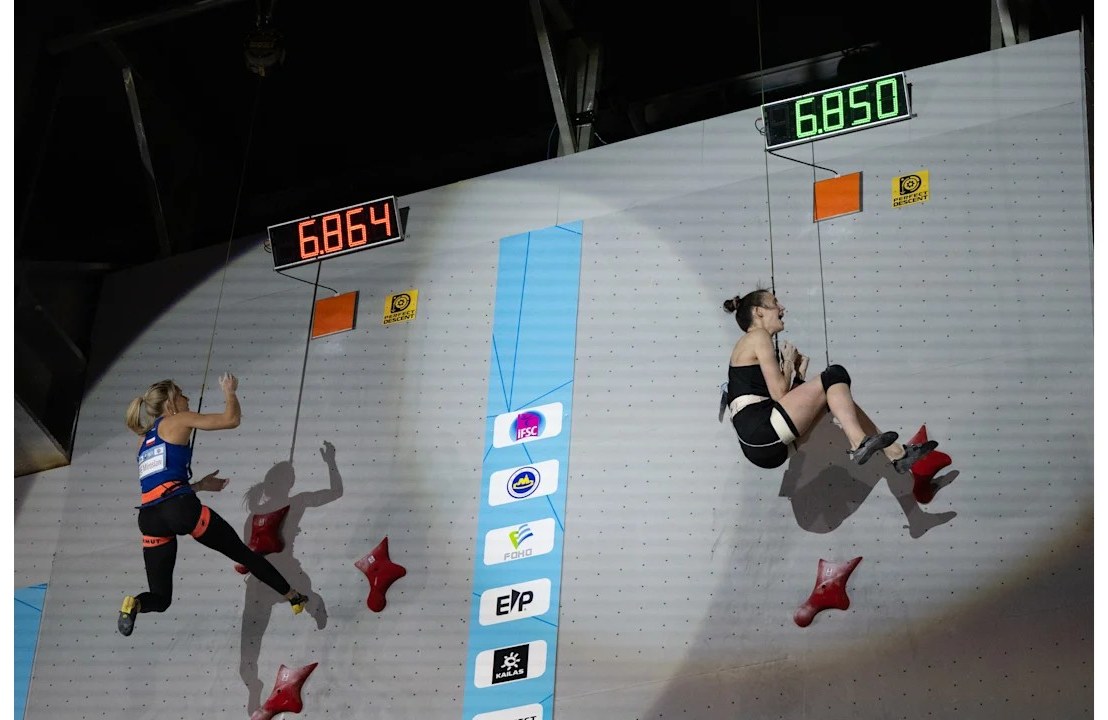
American Emma Hunt faced off against the fastest woman in the world, Aleksandra Miroslaw of Poland. Miroslaw slipped low on the wall and had another stumble on the way up putting her well behind her typical pace. This opened the door for Hunt, but she slipped with just a few holds to go. Ultimately, Hunt touched the pad in 6.85 seconds, while Miroslaw touched one hundredth of a second later, sending Hunt to the semifinals and ending Miroslaw’s competition. In the semis, Hunt had the second fastest time, but the fastest was put in by the other woman on the wall, Jimin Jeong, while Shaoquin Zhang advanced to the final after Lijuan Deng fell in their race. 

Hunt put in her best time on the day in the Small Final but, ultimately, it was not enough as Deng put together an impressive 6.34 to win the bronze medal. Jeong was unable to beat Zhang, who took home gold in the Final in front of her home crowd.

On the men’s side world record holder Sam Watson flirted with his record time in qualifications, and again in the round of 16, but “slowed” down to 4.81 in the quarterfinal and advanced. The surprise then came when Hryhorii Ilchyshyn managed to beat Watson in the semifinal with a time of 5.11, while Watson put in one of his slower competition times of 5.17. Jianguo Long just did touch ahead of Kimoral Katibin, 4.81-4.83, meaning Katibin was relegated to the Small Final despite a PR. In that Small Final, Watson again put in a time over five seconds, while Katibin set a new PR of 4.75 to win bronze. Long vs. Ilchyshyn was not the final most were expecting, but it was a heck of a race, with them touching just a tenth of a second apart and, despite climbing sub-5 seconds for the first time ever, Ilchyshyn was unable to get gold and had to settle for the silver. 

The Lead climbing was even more bizarre than the Speed. While Mia Krampl finished 1+ holds out of making the final, her bat hang chalk/rest move in the qualifications might have been the most fun visual of the weekend. In the final, Laura Rogora was climbing well, but wound up spending far too much time and energy trying to find a way to statically get across what was a rather clear campusing jump traverse move and ultimately finished fourth. Annie Sanders got to 39+ and won bronze, while both Chaehyun Seo and Erin McNeice got to hold 41. They both happened to fall on that hold and, much to the shock and confusion of the commentary team, fans, and even competitors, both fell at exactly 4:26. Ultimately, this meant a shared gold between McNeice and Seo, Seo’s first gold since 2022 and the first for McNeice.

There were some surprising names that did not make it to the final on the men’s side, but none bigger than Olympic gold medalist Toby Roberts. Once the final did start, the oddities didn’t end. In his first ever final, Neo Suzuki downclimbed a hold to clip the quick draw and wound up getting assistance from the rope. After review, it was determined to be a belayer error and he was allowed to climb again. He made the most of his opportunity to get on the wall again, getting to hold 40 and made an attempt to 41, a full hold further than Alberto Gines Lopez, who finished third in his return to the podium. The Japanese prodigy Sorato Anraku was the last to come out and proceeded to fly up the wall with little trouble, topping out with 1:18 left on the clock. 

Lead and Speed come back again next weekend, this time in Bali.

2025 IFSC Boulder World Cup – Keqiao

2025 IFSC Boulder World Cup – Keqiao

The IFSC World Cup season has officially arrived as the boulder event in Keqiao, China took place over the weekend. This comes on the heels of a winter that saw the official announcement from the International Olympic Committee (IOC) that the three disciplines, Boulder, Lead, and Speed, will all have their own medals, allowing for specialization.

In the Tokyo Olympics the three disciplines were merged together, which created an odd look of elite boulder and lead climbers like Brooke Raboutou (fall) and Chaehyuon Seo (10.64) struggle. In 2024, the IOC separated Speed from Boulder and Lead, making for a more representative competition, but still had some athletes, Natalia Grossman, who specialize in Boulder really struggle on Lead, and vice versa.

The separation of the three disciplines will allow for those who do specialize to have a chance at a medal where they would otherwise struggle in the combined event, but this will also likely have us seeing much more specialization across the World Cups. There are also a couple fundamental changes to the competitions this year, with eight athletes making the finals rather than six, and the scoring now being a point system with 10 points for a zone, and 25 for a top with a 0.1 deduction for each attempt after the first.

The women’s qualification and semi finals went rather chalk in terms of those making it through to the next round, with Nekaia Sanders being the last one out in the qualification round, while Mashiro Kuzuu finished ninth in the semifinals and just missed the finals. The final boulders no the women’s side were really tough. Only one climber scored on all three boulders, as Annie Sanders got the zone in boulders one, two, and four, and topped boulder three. Oriane Bertone had the highest score in the semifinals, so she was the last on the mat and came out to boulder four needing a top to take home the title. She flashed the zone but, like every climber before her, failed to top the difficult boulder and Sanders won her second consecutive Boulder World cup. Erin McNeice took home the bronze.

On the men’s side, there were some big names that missed the finals, as Colin Duffy of the United States finished 18th, only scoring on two of the four boulders in the round, and British superstar Toby Roberts failed to top any of the boulders and finished in 15th. In the final, Oren Prihed of Israel failed to top any of the boulders, while Frenchman Paul Jenft only topped one and failed to score on the third. Everyone else topped at least two boulders in the final and scored on every boulder. Maichi Narasaki had an excellent final, topping three of the four and flashing the zone on the fourth, scoring 83.9 points, but ultimately ended up in a distant third place. Sorato Anraku finished second in the semis, so he was second to last on the wall, he entered the final boulder with a 0.2-point lead over Korean Dohyun Lee, meaning a top in two or fewer attempts would guarantee him a gold, and a top on third would land him with tied for first as the worst-case scenario. In typical Anraku fashion, he flashed the boulder and secured gold and finished just 0.3 points shy of a perfect score. Lee wound up topping the problem on his third attempt, scoring 99.3 points in the event, losing by 0.4.

The next World Cup event comes this weekend as the IFSC heads to Wujiang for both Lead and Speed competitions. The Lead competition does have two big names not in the registrant list, as Raboutou and Slovenian superstar and two-time Olympic gold medalist, Janja Garnbret are not among those who will compete. That said, many of the other top female Lead climbers are expected to compete, and could make for an incredibly tight competition.

Weekend in Climbing: IFSC World Cup in Wujiang and NACS in Virginia

It was a busy weekend in the climbing world as the final IFSC World Cup and the final North American Cup Series events of 2023 both took place. Now, this doesn’t mean we have to wait until next year for some elite climbing, as there are many regional tournaments coming up with a bunch of Olympic spots up for grabs.

One athlete who has yet to secure an Olympic invite but is fully expected to qualify is the 16-year-old phenom from Japan, Sorato Anraku. Anraku dominated yet again as he reached hold 39, while second place, Shion Omata, reached jsut 30+. Anraku ended the season with 4300 points, running away with the season title with second place scoring just 2650 points. A third Japanese climber, Taisei Homma, finished third, giving Japan a podium lockout in China.

The season title was still up in the air coming into the weekend, with Janja Garnbret did not make the trip Jessica Pilz had a chance to secure the title if she were to finish on the podium. She placed fourth in the semi-finals, while Janja’s Slovenian teammate Mia Krampl surprisingly failed to get out of. Both Ai Mori and Natsuki Tanii managed to reach the top during the semi-finals, while Jain Kim matched Pilz with 34 holds.

The women’s final proved to be incredibly difficult, as the high score when Pilz stepped to the wall was just 22+ holds. She blew that number out of the water, reaching hold 31+. Kim wound up falling after hold 20+ giving Pilz the season title. Tanii made it to hold 26+ to secure third and Mori finished her season on top of the podium with 36+.

The speed races featured one shocking result, as world record holder Aleksandra Miroslaw fell in the quarterfinal and placed just fifth. Her national teammate Natalia Kalucka came up just short in the final as Lijuan Deng managed to win the final in front her home fans.

In the men’s speed final featured to Chinese climbers matched up against one another, with Peng Wu getting the win against Jingjie Huang.

Locally, the Elite National Sportrock Climbing Centers in Alexandra, Virginia hosted the final NACS event of the year. Micaela Patajo won the women’s speed competition, while Kaden Kang won the men’s competition. In lead, three men reached the top in the final, with Victor Baudrand reaching to top quickest and taking home victory. On the women’s side it was domination by Julia Duffy. While she only won the final by a single hold, she did finish first in qualification, the semi-finals, and the finals, sweeping the weekend.

2023 IFSC Climbing World Cup: Koper, Slovenia

Yes, it is a bit late to be joining into the 2023 Climbing World Cup season, especially given this was the second to last event of the season and many of the top climbers won’t be participating in China. That said, it is a sport that I have recently begun participating in and very much following, so let’s get some extra publicity to the sport of climbing.

The women’s lead title was crowned in the nightcap, which was fitting as Slovenia had three native climbers in the eight-woman final. It was heartbreak for Mia Krampl as her foot slipped after hold 11 going a dyno into the next section and leaving a clear black rubber streak on the foothold serving as a warning to all the climbers who came after her.

Another Slovenian climber, Vita Lukan, managed to bring home the bronze medal in a riveting climb. She lost her chalk bag in an incredibly technical section that saw all but one climber, Mori Ai (more on her in a moment), end up with their backs facing the wall and spinning around their rope to solve the most notable crux in the route. As she spun, the clip for her chalk bag came undone and snag on one of her harness loops. She reached back to get a handful of chalk but instead set the bag free to fall to the ground. Somehow unphased, Lukan continued climbing to the 40+ hold mark, which was just enough to earn a spot on the podium.

Ai put together an impressive climb, especially given the setup did favor the taller climbers, and she was the shortest in the final. As mentioned before, she was the only one not to go for the reverse hold and spin in the middle of the wall, instead putting in an impressive heel hold to get through the crux and ending up nearly reaching the top, before falling at 44+.

The final climber of the day was climbing superstar Janja Garnbret, and she put on a show for her home crowd. The fans were incredibly loud for her entire climb, regularly chanting “Janja” and “Slovenia” as she made the problem that stumped every climber before her look almost simple. She breezed her way to the top to claim gold.

On the men’s side, there was again only one climber to top the route, and he was also the last competitor to go. Anraku Sorato of Japan showed why he is a future star in the sport as he absolutely dominated the wall and made it look even easier than Janja did the women’s route. American Jesse Grupper found himself burning too much time at one of the most unique features you will see on a lead route. The right-handed swinging move that leads to a slight down jump before a full dyno with an underhand hold would be intimidating on a bouldering wall, it in the middle of a lead route is borderline crazy. Despite the uniqueness of the feature, every single climber did successfully solve it.

Grupper though did spend a lot of time in that section which led to him seeming to rush at the end as he found himself with a handful of maneuvers to complete with only 20 seconds left and fell on hold 42+. It really was a two man show as the bronze medal went to Olympic champion Alberto Gines Lopez, who only made it to hold 23.