Tag: Erin McNeice

IFSC Koper Lead World Cup Recap: Home Golds, Heartbreak, and Season Crowns

IFSC Koper Lead World Cup Recap: Home Golds, Heartbreak, and Season Crowns

Men’s Recap

Setting the Stage

In Koper’s golden evening, the setters delivered a route as poetic as it was punishing—flowing with rhythm, decision moments, and momentum. It was climbing as cinema, every hold a scene.

Bright Liminals & Early Exits

The climb’s elegance made even a tiny slip feel seismic. Neo Suzuki’s right foot popped early, ending his final at 10+, a gut-punch exit from one of the favorites.
Putra Tri Ramadani quietly became another headline—Indonesia, known for speed climbing dominance, now showing real promise in lead. His first World Cup final was a breakthrough.

Olympic Glory vs World Cup Glory

All eyes were on Alberto Gines Lopez—an Olympic gold medalist yet still chasing his first World Cup win. He climbed to 47, sealing a medal and his best shot yet at that elusive gold. But Toby Roberts followed and fell at 46, cementing Gines Lopez’s silver.

Only One Japanese Climber Could Medal

Satone Yoshida sat nervously on the bubble of the podium with a score of 45, watching as his compatriot Sorato Anraku close the competition. Anraku delivered, reaching 48 to clinch gold—and leave Gines Lopez still chasing his first World Cup victory.

Men’s Podium – Koper Lead World Cup

RankClimberResult
1Sorato Anraku (JPN)48+
2Alberto Gines Lopez (ESP)47+
3Toby Roberts (GBR)46+

Women’s Recap

Slovenia’s Sisters Take the Stage

In the electric atmosphere of Koper, four Slovenian women earned tickets to the final—an emphatic home showcase of depth and talent. Janja Garnbret, in peak form, shared a perfect semi-final climb with South Korea’s Seo Chaehyun, setting up a heavyweight battle in front of Garnbret’s home crowd.

Early Benchmarks

Erin McNeice climbed with a methodical approach, taking her time through the wall. She struggled with the clip before the roof but fought through, becoming the first to touch the headwall. Her climb ended just after, and though she held the high mark through four climbers, her disappointment was plain.

Laura Rogora, often tested by the big dynamic moves, managed to find a more static solution through the dyno. True to form, she flirted with the clock, still in the roof with 30 seconds left. She reached the headwall and guaranteed herself a medal, falling with just a handful of seconds to spare.

The Queen of Koper

Janja Garnbret is only competing in three World Cups this season, and hearing the roar when she stepped to the wall made it obvious why Koper was one of them. She reached the headwall with more than two minutes still on the clock, the crowd growing louder with each move. The finish required a taxing traverse rightward before a dyno to the last hold. Her right foot slipped on the leap, leaving her one hold shy of the top—but the ovation thundered anyway.

The Decider

Seo Chaehyun climbed with McNeice sitting on the bubble at 33. She steadied herself after a wobble around 24 and pressed higher. Once she touched the headwall the podium was set, bumping McNeice out. Seo fell at 38, edging past Rogora’s 37+ to lock in silver and confirm Garnbret as Koper’s champion.

Women’s Podium – Koper Lead World Cup

RankClimberResult
1Janja Garnbret (SLO)47+
2Seo Chaehyun (KOR)38+
3Laura Rogora (ITA)37+

2025 IFSC World Cup Bali: Lead and Speed

2025 IFSC World Cup Bali: Lead and Speed

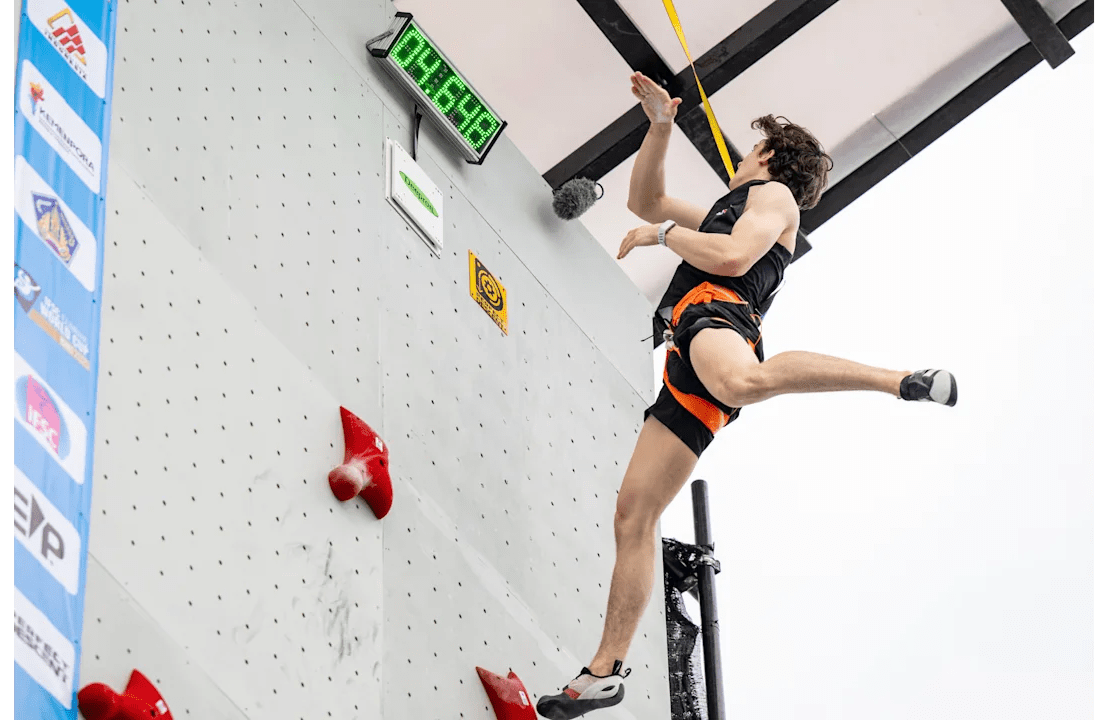
Under the stunning backdrop of crashing waves in Bali, nobody shined brighter than American Samuel Watson. In the semi-finals, he blitzed up the wall in 4.67 seconds, breaking his own world record set at the 2024 Paris Olympic Games. In the final, he lined up next to Ryo Omasa looking to take his first gold this season and he clinched it in anticlimactic fashion when Omaso was called for a False Start, handing the gold to Watson. That wasn’t the end though, as Watson took the opportunity afforded to him and chose to go ahead and climb the wall once, uncontested, just he and the clock. Unbelievably, he bettered his semi-final time and set yet another world record, hitting the scoring pad in just 4.64 seconds. 

After a surprise early exit before the medals a week ago, Alesandra Miroslaw absolutely dominated the speed wall for the women. Once getting through qualifications, she did not allow a race to even be close, winning all four races by a minimum of six tenths of a second. Yafei Zhou got the silver, while Adi Asih Kadek won the Small Final in front of her home crowd to take home the bronze medal. 

The shock of the weekend came when Sorato Anraku fell moving to the 25th hold in the semi-finals, meaning he finished 16th, well outside the finals after gold in the opening boulder and lead events of the season. This opened the door for a new winner in the men’s final, which featured a sideways jump rather low on the wall that, while not immensely difficult, was clearly a move that made the climbers take notice. 

Max Bertone was the first on the wall in the final, and he made it look like it was going to be a high scoring final, getting up the head wall all the way to hold 41 right out the gates. The route was far from forgiving though, as two climbers failed to reach hold twenty, and only three got to hold 31. Alberto Gines Lopez nearly matched Bertone, but fell at 39+. The final climber of the day was Satone Yoshida, and Bertone was still atop the leaderboard. Yoshida’s climb was anything but boring, as he looked to get himself in difficult positions multiple times, none more so than when he got the rope stuck underneath a volume and was really having to fight the rope the final third of the wall. Despite this, he made it to the head wall and reached hold 42, securing himself the gold and knocking Bertone down to silver. 

The women were the nightcap, and they put on an absolute show! Mia Krampl put forth her typical edge of your seat performance and made it near the headwall, but that was only good enough for 7th. Ai Mori reached the top of the wall and clipped in, but time had run out, meaning she only got credit for hold 45. Still, essentially topping the route put her in an excellent spot, but that wound up only being good enough for bronze. Chaehyun Seo also made it to the top and clipped with time left on the clock after ending in a shared gold medal position a week ago with Erin McNeice . Seo and McNeice were the only two to top the route in the semi-finals, but McNeice had the better qualification score, meaning she got to climb last. McNeice naturally went on to match Seo again, and topped the route with almost the same time yet again, but that qualification score meant McNeice got to claim the gold all to herself, and Seo was awarded silver. Seo and McNeice are quickly becoming a rivalry to watch this IFSC season. 

The next IFSC World Cup event comes May 16-18 as we go back to bouldering in Curitiba, Brazil, where there was a recent fire at the facility but all reports are the event will be able to proceed without issue.

2025 IFSC Boulder World Cup – Keqiao

2025 IFSC Boulder World Cup – Keqiao

The IFSC World Cup season has officially arrived as the boulder event in Keqiao, China took place over the weekend. This comes on the heels of a winter that saw the official announcement from the International Olympic Committee (IOC) that the three disciplines, Boulder, Lead, and Speed, will all have their own medals, allowing for specialization.

In the Tokyo Olympics the three disciplines were merged together, which created an odd look of elite boulder and lead climbers like Brooke Raboutou (fall) and Chaehyuon Seo (10.64) struggle. In 2024, the IOC separated Speed from Boulder and Lead, making for a more representative competition, but still had some athletes, Natalia Grossman, who specialize in Boulder really struggle on Lead, and vice versa.

The separation of the three disciplines will allow for those who do specialize to have a chance at a medal where they would otherwise struggle in the combined event, but this will also likely have us seeing much more specialization across the World Cups. There are also a couple fundamental changes to the competitions this year, with eight athletes making the finals rather than six, and the scoring now being a point system with 10 points for a zone, and 25 for a top with a 0.1 deduction for each attempt after the first.

The women’s qualification and semi finals went rather chalk in terms of those making it through to the next round, with Nekaia Sanders being the last one out in the qualification round, while Mashiro Kuzuu finished ninth in the semifinals and just missed the finals. The final boulders no the women’s side were really tough. Only one climber scored on all three boulders, as Annie Sanders got the zone in boulders one, two, and four, and topped boulder three. Oriane Bertone had the highest score in the semifinals, so she was the last on the mat and came out to boulder four needing a top to take home the title. She flashed the zone but, like every climber before her, failed to top the difficult boulder and Sanders won her second consecutive Boulder World cup. Erin McNeice took home the bronze.

On the men’s side, there were some big names that missed the finals, as Colin Duffy of the United States finished 18th, only scoring on two of the four boulders in the round, and British superstar Toby Roberts failed to top any of the boulders and finished in 15th. In the final, Oren Prihed of Israel failed to top any of the boulders, while Frenchman Paul Jenft only topped one and failed to score on the third. Everyone else topped at least two boulders in the final and scored on every boulder. Maichi Narasaki had an excellent final, topping three of the four and flashing the zone on the fourth, scoring 83.9 points, but ultimately ended up in a distant third place. Sorato Anraku finished second in the semis, so he was second to last on the wall, he entered the final boulder with a 0.2-point lead over Korean Dohyun Lee, meaning a top in two or fewer attempts would guarantee him a gold, and a top on third would land him with tied for first as the worst-case scenario. In typical Anraku fashion, he flashed the boulder and secured gold and finished just 0.3 points shy of a perfect score. Lee wound up topping the problem on his third attempt, scoring 99.3 points in the event, losing by 0.4.

The next World Cup event comes this weekend as the IFSC heads to Wujiang for both Lead and Speed competitions. The Lead competition does have two big names not in the registrant list, as Raboutou and Slovenian superstar and two-time Olympic gold medalist, Janja Garnbret are not among those who will compete. That said, many of the other top female Lead climbers are expected to compete, and could make for an incredibly tight competition.