Author: Shaun P Kernahan

China’s Golden Week: World Games End in Chengdu Coronation

China’s Golden Week: World Games End in Chengdu Coronation

The World Games in Chengdu closed on a high, but the week began in heartbreak. Italian orienteer Mattia Debertolis was found unconscious on the course August 8 and tragically passed away days later at just 26. A civil engineer and PhD student at Stockholm University, Debertolis was more than an athlete — he was a rising mind and a competitor taken too soon. His loss hit the Games with a weight that no medal tally can balance.

But as it always does, sport pressed forward — and the action was fierce.

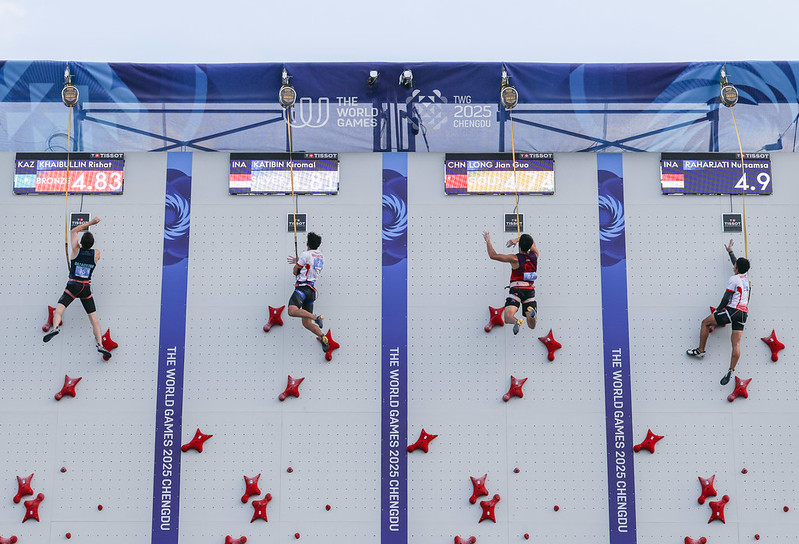
Speed climbing stole the spotlight. Six golds were up for grabs, and China made it clear this was their wall. On the men’s side, world record holder Sam Watson looked ready to cash in, but home favorite Shou Hong Chu snatched gold with a 0.16-second edge that might as well have been a mile at that pace. The women’s podium? Forget balance — China slammed the door, sweeping all three spots. Li Juan Deng held off Yu Mei Qin by one-hundredth of a second. Yes, 0.01. That’s literally the blink of an eye. Qin doubled up on silver in speed 4, while Indonesia’s Desak Made Rita Kusuma Dwei broke through for gold. Jianguo Long’s personal best 4.74 in the men’s event added more proof: this was China’s house.

The relays drove the point home. Chinese women finished one-two like it was a national training run, and the men put the United States in their rearview to claim another gold. At that point, the only question left was how much hardware the hosts could carry out of their own building.

Flag football brought one of the few shocks of the week. Team USA — heavy favorites and looking like a lock — got clipped by Mexico in the women’s gold medal game, 26–21. It was the kind of upset that flips a script and reminds you why trophies aren’t handed out on paper.

By the time the curtain dropped, the medal count looked like a demolition. China racked up 64 total medals, 36 of them gold — double Germany’s haul, and then some. Italy finished second in total hardware with 57, while Germany’s 17 golds kept them just barely in the conversation less than half of the hosts while still being nation with the second most athletes standing at the top of a podium.

Now the torch moves to Europe. Karlsruhe, Germany, gets the next crack at hosting in 2029. The question: can anyone else make it their Games, or will we be talking about China’s dominance all over again in four years?

Fantasy Football Draft Strategy: Lock in RBs Early, Clean Up WR Value Late

Fantasy Football Draft Strategy: Lock in RBs Early, Clean Up WR Value Late

Round 1: Best Available… But Watch RBs Closely

Go “best player available” in the first round, but if you have a shot at an elite running back, take it. The RB pool dries up fast. In a 12-team league, there are 24 starting spots at minimum, and several managers will flex an RB too. By the time you’re looking past the top 24, you’re in uncertainty territory — think the Giants, Cowboys, or Jaguars backfields, where no one knows who will hold the job all year.

That’s why my early priority is to secure two, ideally three, strong RBs before the talent cliff hits.


WR: Depth for Days

The top WRs are elite, but this position is loaded. You can find quality starters well after round five. Even outside the top 24, you’ll see names like Zay Flowers, Jameson Williams, Rashee Rice, Xavier Worthy, Jacoby Meyers, Calvin Ridley, Stefon Diggs, and Jerry Jeudy — plenty of upside without an early-round price tag.

With that in mind, I’ll bulk up on WRs later, aiming for high-upside flyers like Keon Coleman or Luther Burden in the late rounds. Both have breakout potential if the situation breaks their way.


TE: The Shallow End of the Pool

Tight end is top-heavy. If you wait until the very end, you’re staring at Tyler Warren, Dallas Goedert, or Dalton Kincaid — decent players, but not difference-makers. Unless you’re punting the position entirely, grab one before the drop-off.


QB: Depth That Lasts All Draft

Quarterback is the opposite story — it’s deep. Even after backups are taken, you can still find intrigue. Drake Maye could deliver with his rushing ability and the Patriots’ upgraded offense. JJ McCarthy is another late-round lottery ticket.

Here’s the case for McCarthy: Sam Darnold — yes, that Sam Darnold — finished as a top-10 fantasy QB last year in Minnesota. Now McCarthy, a first-round pick with legit mobility, steps into that same offense. Risk? Sure. But top-10 upside is there.


Bonus Rule Change: Reward the 60+ Yard Bombs

Kicker scoring hasn’t caught up to the modern game. Right now, most leagues give:

  • 3 points for 0-39 yards
  • 4 points for 40-49 yards
  • 5 points for 50+ yards

That made sense when 50-yarders were rare. Now they’re routine. We’re seeing 60+ yarders regularly — even a 70-yarder from Cam Little this preseason.

My fix: make 50-59 yards worth 5 points, and add a 60+ yard category worth 6 points. It would boost the value of big-leg kickers from afterthoughts to potential draft targets.

Where to Find USMNT Players in Europe This Season

Where to Find USMNT Players in Europe This Season

The European soccer season is kicking off, and plenty of American players—past, present, and future USMNT stars—are on the move. Some transfers are done, others are still hanging in the balance, but here’s your guide to who’s playing where and which clubs to keep an eye on if you’re following the U.S. men’s national team.


Still Waiting on Final Moves

  • Gio Reyna, Yunus Musah, Josh Sargent, Ricardo Pepi – All are linked with transfers, but nothing’s official yet. Expect late-window drama here.

Completed Transfers & Loans

  • Matt Turner – Looked set for Lyon until the club’s financial troubles complicated the deal. It eventually went through, but Turner has been loaned back to New England Revolution in MLS. The move should give him much-needed minutes as he battles for the No. 1 goalkeeper spot ahead of the home World Cup.
  • Malik Tillman – After a standout season at PSV, the versatile attacker joins Bayer Leverkusen in the Bundesliga. With Florian Wirtz off to Liverpool, Tillman has a genuine shot at regular starts.
  • Timothy Weah – Loaned to Marseille, where his father once played. His throwback magazine cover recreation for the announcement was an instant classic.
  • Johnny Cardoso – Moves from Real Betis to Atletico Madrid. Playing time could be scarce under Diego Simeone, but if Cardoso becomes a regular, his spot on the World Cup roster would be almost certain.
  • Damion Downs – After a brief USMNT cameo this summer, the striker joins Southampton in the EFL Championship.
  • Patrick Agyemang – Heads to Derby County, also in the Championship. This league has been a strong springboard for Americans in recent years.
  • Caleb Wiley – On loan to Watford, another Championship side.
  • Julian Eyestone – The 19-year-old goalkeeper is now with Brentford’s senior squad in the Premier League, serving as a backup.

Clubs with Multiple USMNT Players

While the days of big “American hubs” in Europe are fading, a few teams still have more than one U.S. player:

  • Celtic (Scottish Premiership) – Cameron Carter-Vickers and Auston Trusty anchoring the defense.
  • AC Milan (Serie A) – Christian Pulisic plus Yunus Musah—for now. Musah’s transfer rumors are heating up.
  • PSV (Eredivisie) – Sergiño Dest and Ricardo Pepi, though Pepi could still move before the window closes.
  • Eintracht Frankfurt (Bundesliga) – Veteran Timmy Chandler and Paxten Aaronson.
  • West Bromwich Albion (EFL Championship) – George Campbell and Daryl Dike, though neither is likely to feature at the next World Cup.

Bottom line: American players are scattered more widely than in past seasons, but there’s still plenty to watch across Europe’s top leagues. The real intrigue will come in the next few weeks as Reyna, Musah, Sargent, and Pepi finalize their futures.

The World Games 2025: The Olympics’ Quirky Cousin Is in Full Swing

The World Games 2025: The Olympics’ Quirky Cousin Is in Full Swing

The World Games 2025 are underway in Chengdu, and 134 gold medals have already been handed out. If you’re asking, “What are The World Games?”—think of them as the Olympics’ eccentric cousin. They happen every four years, the summer after the Summer Olympics, and debuted in 1981 in Santa Clara, California.

For many sports, this is their biggest stage—the equivalent of the Olympics—though some Olympic events sneak in too, like karate, taekwondo, speed climbing, and archery. This year’s edition features 35 sports and will award a total of 253 gold medals by the end.

Unexpected Highlights
Men’s softball is back for the first time since the inaugural Games. But the real charm lies in events you’ve probably never seen—korfball, drone racing, and wushu.

Korfball is the ultimate “this feels familiar but… what is happening?” sport. Invented in the Netherlands in 1902, it blends basketball and netball, but with its own odd rules. The hoop—called a korf—is a big yellow cylinder atop an 11.5-foot pole. Players shoot what looks like a soccer ball into it for points. Teams have two men and two women on each end, and defenders can only guard the same gender. Every two goals, players switch ends so everyone plays both offense and defense. And here’s the kicker—no dribbling, so we have found Klay Thompson’s retirement sport. With no dribbling, the ball is in constant motion for all four 10-minute quarters.

In the bronze medal match, Chinese Taipei beat Czechia 19–15, while Belgium and the Netherlands were still battling for gold at the time of writing. The beach version kicks off soon, so keep an eye out.

Martial Arts Meets Acrobatics
Wushu is part martial art, part dance, part aerial stunt show. I’ve watched plenty, and while I couldn’t pretend to explain the scoring, it’s mesmerizing.

Beach handball also delivers pure chaos and style points—literally. A goal after a full 360° spin is worth two points instead of one, which means players are constantly launching themselves into twirling shots that look like highlight reels waiting to happen.

Archery Perfection
One of the Games’ jaw-dropping moments came in the men’s compound archery final. Mike Schloesser of the Netherlands took on Curtis Lee Broadnax of the USA and delivered a flawless performance—fifteen arrows, fifteen bullseyes, a perfect 150.

The Most Entertaining Call of the Games
The women’s 55 kg karate final gave us a name the announcers will never forget—Germany’s Mia Bitsch. Yes, it’s pronounced exactly as you think, and yes, we got to hear “Bitsch wins gold!”

What’s Next
I’m counting down to the women’s flag football medal rounds on Sunday, August 17. And speed climbing—Wednesday through Friday—is must-watch madness. I’ll be back next week to recap the rest of the action from the wonderfully weird world of The World Games.

2025 F1 Weekend Recap: Hungary

2025 F1 Weekend Recap: Hungary

The final race weekend before the summer break brought plenty of drama on the track across all three levels, and some news broke off the track, as Max Verstappen put rumors to rest and confirmed he will be back with Red Bull in 2026. 

Rafael Camara came into the weekend with a shot at becoming the first ever F3 driver to wrap up the championship before the final weekend. He went out in qualifying and secured pole by a miniscule 0.008 seconds over championship rival Mari Boya. Knowing a win on Sunday would secure the title, Camara played the sprint race safe. A number of cars found themselves out in the race, but there was a good race at the front, as Ugo Ugochukwu gave it a good run, but Tasanopol Inthraphuvasak held him off and took the checkered flag. Charlie Wurtz finished third in the sprint.

The featured race started in the wet with it a rolling start, and the track was slippery all race. Brad Benavides found himself in the wall after making contact with Roman Belinski bringing out the first safety car of the day on lap 4. Later on in the race Gerrard Xie was off the track on the inside before rejoining and sliding up the track, taking out Ugochukwu to bring out the second safety car. There was another incident on track later on that saw several cars make contact with each other but somehow all were able to continue down the road and avoided a safety car. 

Ultimately Tuukka Taponen finished third behind Boya, but it was Camara woh crossed the line first, securing the championship with one race weekend to go. That final race weekend on the F3 calendar is Monza September 5-7, where Camara will be able to drive without any championship pressure on him individually, but his Trident team has just a 19 point lead over Campos Racing, who have racers ranked two and three in the championship in Boya and Nikola Tsolov.

The F2 weekend sprint started with Arvid Lindblad and Campos Racing teammate Pepe Marti battling right from lap one. This ultimately led to trouble for Lindblad, as he took far too much out of his tires and started moving back after doing a really good job holding other racers off, but ultimately finished tenth. On the final lap, and the penultimate turn, Marti just did have his wheels ahead of Alex Dunne which allowed him to essentially force him off track without penalty to hold on and take the checkered flag, with Dunne finishing second and Jak Crawford third. 

In the feature race, it was an all Invicta front row with Roman Stanek on poll looking of his third F2 win, but first in which he would hear his country’s national anthem played as he inherited both previous wins after post race penalties. Armoury Cordeel retired due to an engine issue as he began lap 6, the first lap that pit stops are permitted, but a full safety car never came out, instead only a VSC meaning the pit road was closed and those on the softer tire could not get a cheap early stop. Then, on lap 10 another VSC came out as Victor Martins had to retire, but again no pit stops allowed. Ultimately pit stops had to come at full racing speed, and Leonardo Fornaroli, who had gotten by Stanek early on, was given a five second penalty for speeding in the pit lane. Despite that penalty, Fornaroli wound up extending his lead out front and securing the victory. Stanek finished second and Crawford got his second third place finish on the weekend. Lindblad again found himself one of the slower cars on the track in the final laps, but put on a masterclass of defending and held off a stack of cars to hold on to sixth place.

There are four race weekend left in the F2 season, with the next coming at Monza starting September 5th, Fornaroli has an 18 point lead over Crawford who is two points ahead of Richard Verschoor who is ten ahead of Luke Browning, a point clear of Dunne. Meanwhile Invicta holds a pretty healthy lead ahead of Campos in the team championship.

F1 looked like it was going to be a McLaren runaway weekend again during the three practices, but qualifying kept things interesting. Yuki Tsunoda found himself out in Q1 while Kimi Antonelli and Lewis Hamilton were both eliminated in Q2. While Lando Norris and Oscar Piastri both put in solid laps in qualifying, Charles Leclerc put together a special lap and took a somewhat surprising pole position. On race day, Norris looked to make a move on teammate Piastri in turn one, but was unable to get the move done and wound up sliding form third to fifth and George Russell and Fernando Alonso both got by Norris in the first lap. Norris was able to get by Alonso within a few laps, but couldn’t catch Russell.

Norris being somewhat stuck in fourth forced McLaren to rethink strategy and left him out for a long stint to give a one stop race a try. Meanwhile, Piastri boxed before Leclerc to attempt to get the undercut, but was not able to catch him after the first stop. Leclerc was clearly not happy with something on his Ferrari or the strategy as he was regularly on the radio complaining and, after stop two, found himself moving backwards and going from a guy with control out in front of the race to missing the podium all together on lap 62. 

Norris managed to make his tires hold on, but Piastri made a real run and attempted a move late in the race, nearly making contact with Norris, but both managed to avoid contact and Norris stayed out front and took the checkered flag. Pastry came in second with Russell rounding out the podium. F1 now goes into their summer break, with their next race coming in Zandvoort the final weekend of August, as McLaren extend their lead in the constructor’s title even more, but the driver championship now has just nine points separating Piastri at the top from his teammate Norris. 

2025 F1 Weekend Recap: Belgium

2025 F1 Weekend Recap: Belgium

Reports are that Oscar Piastri set a new track record in SQ3 at Spa, but most fans in the United States had no visual evidence of that happening. See, with about 4 minutes to go in the final qualifying session for the sprint race, ESPN went to commercial. Those who were watching via the stream didn’t get to see the finish. Those watching live on TV got to watch the final lap, but the commentary swapped to the Spanish language stream. 

The big stories coming out of spring qualifying though were the spin from Lewis Hamilton that saw him eliminated in SQ1, and a rough session from Kimi Antonelli that also saw him out in the first session. Once the sprint race started, Max Verstappen immediately took advantage of the low downforce wing he has on his car and jumped ahead of Piastri. Vertappen never looked back as he dominated sectors one and three, making his lead insurmountable despite the McLaren’s being faster in sector two. Ultimately, it was Vertappen on top of the podium in the country of his birth, followed by Piastri and Lando Norris. 

Earlier in the day, F3 had a rather straight forward race that saw Noah Stromsted win the sprint with Ugo Ugochukwu and Charlie Wurtz also making the podium. Straight forward is never used to describe a F2 race, and Saturday was no different. Multiple incidents on the first lap brought out the first safety car, but it was the one that was brought out by Amaury Cordeel making contact and then rolling through the gravel into the barrier on lap 12 that really made it interesting. Much of the midfield boxed for soft tires during the one lap safety car, and their pace was immediately felt. That group made quick work of multiple runners still on medium tires, but Leonardo Fornaroli looked in command of the lead, but Victor Martins and Gabriele Mini were certainly at risk. That risk came to an end though when Sami Meguetounif’s car stopped on track and was unable to get it going again, making the top three Fornaroli-Martins-Mini. 

After the sprint race fun, the F1 qualifying began for the featured race. With rain forecasted for Sunday and the struggles in the wet weather in Silverstone, Verstappen swapped to a rear wing that provided more downforce, which came as a bit of a surprise after the lower downforce wing is what helped lead him to victory in the sprint. Antonelli again found himself out in Q1, making it an incredibly frustrating weekend for the rookie. Meanwhile, Hamilton got himself out of Q1 on his final lap that moved him up to seventh on the timing sheet. When the broadcast got back from commercial though, that had changed. Despite there not being a great angle for it on the broadcast, the stewards determined Hamilton exceeded track limits on turn four and fell to 16th, meaning he did not get out of either Q1 on the weekend. 

Once we reached Q3, the track temperature rose throughout the session leading to the track negatively evolving and few drivers improved on their final lap. This allowed Norris to hold onto pole and Piastri making it a front row lockout for McLaren. One driver who did improve on the final lap was Alex Albon who put together a fantastic final lap and jumped to fifth on the grid.

Come Sunday, the rain did arrive, so much in fact the F3 feature race never officially got started, leaving Rafael Camara 28 points clear at the top of the standings with a race weekend around Hungaroring next weekend and a trip to Monza at the start of September as the only racing left in the F3 calendar for this year. F2 did get going and was relatively straight forward race, at least for a while. Sebastian Montoya spun and stalled on lap 18, bringing out the first and only safety car in the race. Just as we thought the safety car might come in, Oliver Goethe had his engine catch fire, red flagging the race and giving Alex Dunne the win, for a bit. Ultimately Dunne was given a 10 second penalty for failing to engage the start-up procedure, making Arvid Lindblad the winner, for a short time. Lindblad was ultimately found to have issues with tire pressure and was disqualified from the race, making Roman Stanek the official winner. F2 will also be racing next weekend in Budapest, and have four more races after that with Fornaroli holding just a three point lead over Richard Verschoor and only 12 points clear of fifth place. 

The F1 race went for a formation lap behind the safety car before being red flagged and postponed for quite some time. Eventually they got back on the road, but spend the first four laps behind a safety car before a rolling start. There were four cars scheduled to start from pit lane, but it was the McLaren’s up front that everyone was watching. At almost the same spot Verstappen passed Piastri on the first lap of the sprint race, Piastri got by Norris in the feature race. Despite starting in the wet before moving to dry tires not too deep into the race, there weren’t any significant incidents in the race, and McLaren dominated again, with Piastri taking the checkered flag, Norris finished second, and Charles Leclerc rounding out the podium. Piastri now has a 16 point lead in the driver’s standings over Norris while McLaren holds more than double their closest competitor, 516 points to Ferrari’s 248 (both Norris and Piastri alone have more points than Ferrari or any other team).

F1 will be back at it next weekend before the summer break that will see three consecutive weekends without racing.

2025 IFSC World Cup Bali: Lead and Speed

2025 IFSC World Cup Bali: Lead and Speed

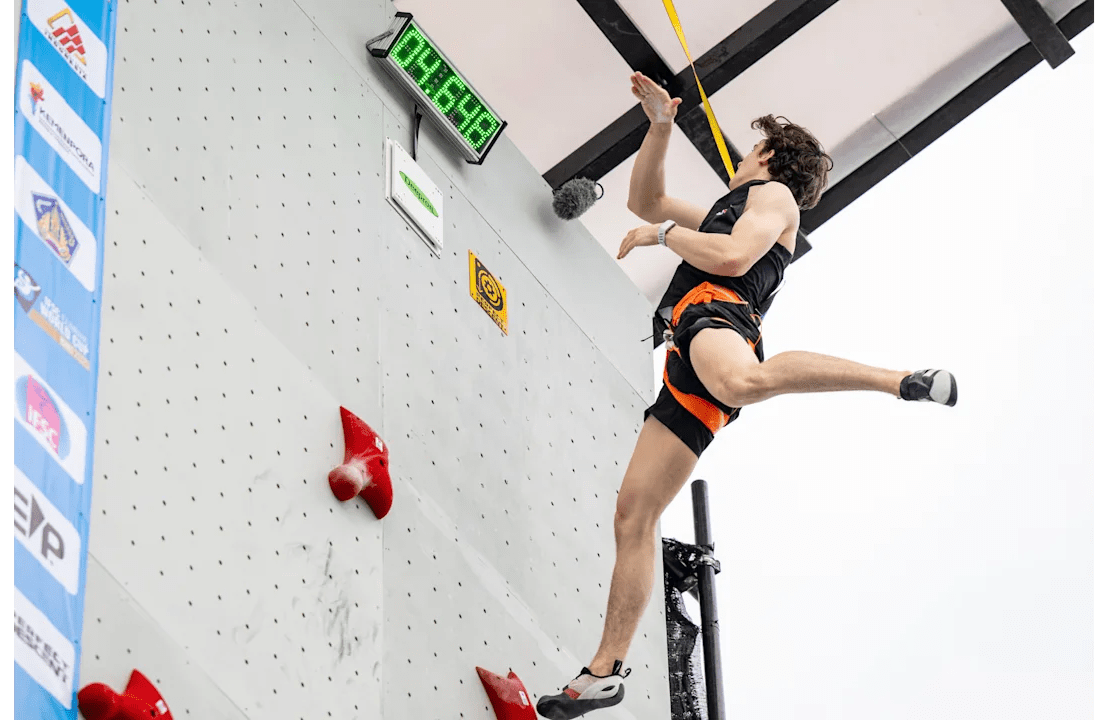
Under the stunning backdrop of crashing waves in Bali, nobody shined brighter than American Samuel Watson. In the semi-finals, he blitzed up the wall in 4.67 seconds, breaking his own world record set at the 2024 Paris Olympic Games. In the final, he lined up next to Ryo Omasa looking to take his first gold this season and he clinched it in anticlimactic fashion when Omaso was called for a False Start, handing the gold to Watson. That wasn’t the end though, as Watson took the opportunity afforded to him and chose to go ahead and climb the wall once, uncontested, just he and the clock. Unbelievably, he bettered his semi-final time and set yet another world record, hitting the scoring pad in just 4.64 seconds. 

After a surprise early exit before the medals a week ago, Alesandra Miroslaw absolutely dominated the speed wall for the women. Once getting through qualifications, she did not allow a race to even be close, winning all four races by a minimum of six tenths of a second. Yafei Zhou got the silver, while Adi Asih Kadek won the Small Final in front of her home crowd to take home the bronze medal. 

The shock of the weekend came when Sorato Anraku fell moving to the 25th hold in the semi-finals, meaning he finished 16th, well outside the finals after gold in the opening boulder and lead events of the season. This opened the door for a new winner in the men’s final, which featured a sideways jump rather low on the wall that, while not immensely difficult, was clearly a move that made the climbers take notice. 

Max Bertone was the first on the wall in the final, and he made it look like it was going to be a high scoring final, getting up the head wall all the way to hold 41 right out the gates. The route was far from forgiving though, as two climbers failed to reach hold twenty, and only three got to hold 31. Alberto Gines Lopez nearly matched Bertone, but fell at 39+. The final climber of the day was Satone Yoshida, and Bertone was still atop the leaderboard. Yoshida’s climb was anything but boring, as he looked to get himself in difficult positions multiple times, none more so than when he got the rope stuck underneath a volume and was really having to fight the rope the final third of the wall. Despite this, he made it to the head wall and reached hold 42, securing himself the gold and knocking Bertone down to silver. 

The women were the nightcap, and they put on an absolute show! Mia Krampl put forth her typical edge of your seat performance and made it near the headwall, but that was only good enough for 7th. Ai Mori reached the top of the wall and clipped in, but time had run out, meaning she only got credit for hold 45. Still, essentially topping the route put her in an excellent spot, but that wound up only being good enough for bronze. Chaehyun Seo also made it to the top and clipped with time left on the clock after ending in a shared gold medal position a week ago with Erin McNeice . Seo and McNeice were the only two to top the route in the semi-finals, but McNeice had the better qualification score, meaning she got to climb last. McNeice naturally went on to match Seo again, and topped the route with almost the same time yet again, but that qualification score meant McNeice got to claim the gold all to herself, and Seo was awarded silver. Seo and McNeice are quickly becoming a rivalry to watch this IFSC season. 

The next IFSC World Cup event comes May 16-18 as we go back to bouldering in Curitiba, Brazil, where there was a recent fire at the facility but all reports are the event will be able to proceed without issue.

2025 IFSC World Cup Wujiang: Lead and Speed

2025 IFSC World Cup Wujiang: Lead and Speed

In the second of three consecutive weekends featuring IFSC World Cups, the focus turned to both Lead and Speed climbers in Wujiang this weekend. The speed climbing saw new milestones and plenty of upsets. 

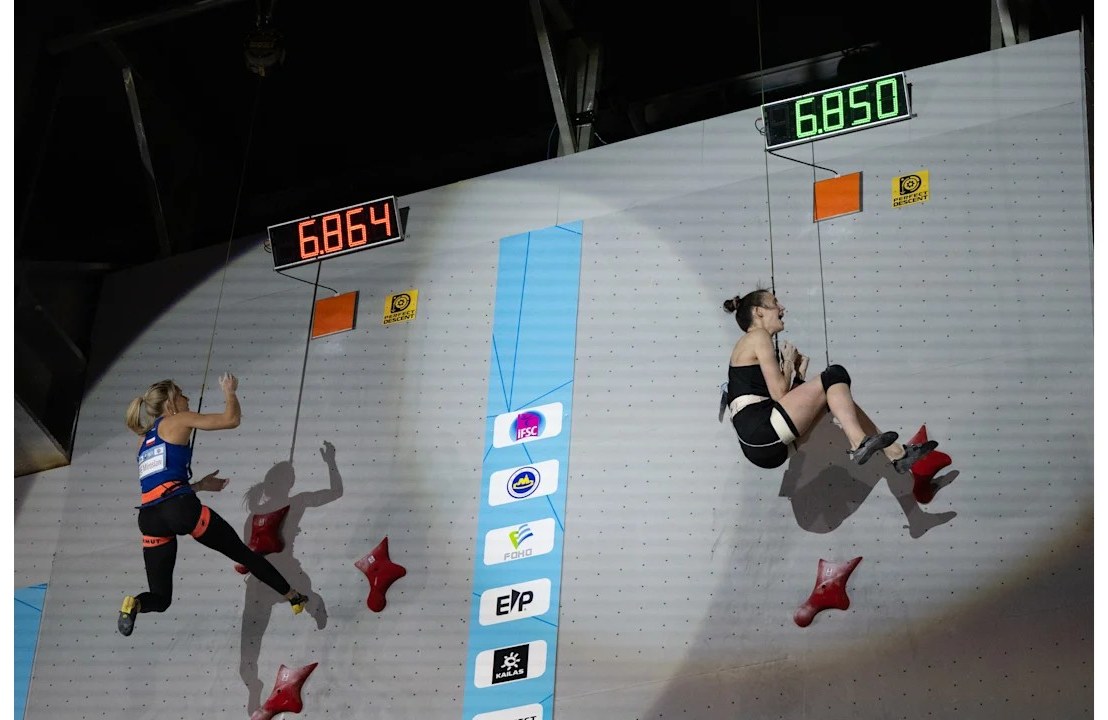
American Emma Hunt faced off against the fastest woman in the world, Aleksandra Miroslaw of Poland. Miroslaw slipped low on the wall and had another stumble on the way up putting her well behind her typical pace. This opened the door for Hunt, but she slipped with just a few holds to go. Ultimately, Hunt touched the pad in 6.85 seconds, while Miroslaw touched one hundredth of a second later, sending Hunt to the semifinals and ending Miroslaw’s competition. In the semis, Hunt had the second fastest time, but the fastest was put in by the other woman on the wall, Jimin Jeong, while Shaoquin Zhang advanced to the final after Lijuan Deng fell in their race. 

Hunt put in her best time on the day in the Small Final but, ultimately, it was not enough as Deng put together an impressive 6.34 to win the bronze medal. Jeong was unable to beat Zhang, who took home gold in the Final in front of her home crowd.

On the men’s side world record holder Sam Watson flirted with his record time in qualifications, and again in the round of 16, but “slowed” down to 4.81 in the quarterfinal and advanced. The surprise then came when Hryhorii Ilchyshyn managed to beat Watson in the semifinal with a time of 5.11, while Watson put in one of his slower competition times of 5.17. Jianguo Long just did touch ahead of Kimoral Katibin, 4.81-4.83, meaning Katibin was relegated to the Small Final despite a PR. In that Small Final, Watson again put in a time over five seconds, while Katibin set a new PR of 4.75 to win bronze. Long vs. Ilchyshyn was not the final most were expecting, but it was a heck of a race, with them touching just a tenth of a second apart and, despite climbing sub-5 seconds for the first time ever, Ilchyshyn was unable to get gold and had to settle for the silver. 

The Lead climbing was even more bizarre than the Speed. While Mia Krampl finished 1+ holds out of making the final, her bat hang chalk/rest move in the qualifications might have been the most fun visual of the weekend. In the final, Laura Rogora was climbing well, but wound up spending far too much time and energy trying to find a way to statically get across what was a rather clear campusing jump traverse move and ultimately finished fourth. Annie Sanders got to 39+ and won bronze, while both Chaehyun Seo and Erin McNeice got to hold 41. They both happened to fall on that hold and, much to the shock and confusion of the commentary team, fans, and even competitors, both fell at exactly 4:26. Ultimately, this meant a shared gold between McNeice and Seo, Seo’s first gold since 2022 and the first for McNeice.

There were some surprising names that did not make it to the final on the men’s side, but none bigger than Olympic gold medalist Toby Roberts. Once the final did start, the oddities didn’t end. In his first ever final, Neo Suzuki downclimbed a hold to clip the quick draw and wound up getting assistance from the rope. After review, it was determined to be a belayer error and he was allowed to climb again. He made the most of his opportunity to get on the wall again, getting to hold 40 and made an attempt to 41, a full hold further than Alberto Gines Lopez, who finished third in his return to the podium. The Japanese prodigy Sorato Anraku was the last to come out and proceeded to fly up the wall with little trouble, topping out with 1:18 left on the clock. 

Lead and Speed come back again next weekend, this time in Bali.

2025 IFSC Boulder World Cup – Keqiao

2025 IFSC Boulder World Cup – Keqiao

The IFSC World Cup season has officially arrived as the boulder event in Keqiao, China took place over the weekend. This comes on the heels of a winter that saw the official announcement from the International Olympic Committee (IOC) that the three disciplines, Boulder, Lead, and Speed, will all have their own medals, allowing for specialization.

In the Tokyo Olympics the three disciplines were merged together, which created an odd look of elite boulder and lead climbers like Brooke Raboutou (fall) and Chaehyuon Seo (10.64) struggle. In 2024, the IOC separated Speed from Boulder and Lead, making for a more representative competition, but still had some athletes, Natalia Grossman, who specialize in Boulder really struggle on Lead, and vice versa.

The separation of the three disciplines will allow for those who do specialize to have a chance at a medal where they would otherwise struggle in the combined event, but this will also likely have us seeing much more specialization across the World Cups. There are also a couple fundamental changes to the competitions this year, with eight athletes making the finals rather than six, and the scoring now being a point system with 10 points for a zone, and 25 for a top with a 0.1 deduction for each attempt after the first.

The women’s qualification and semi finals went rather chalk in terms of those making it through to the next round, with Nekaia Sanders being the last one out in the qualification round, while Mashiro Kuzuu finished ninth in the semifinals and just missed the finals. The final boulders no the women’s side were really tough. Only one climber scored on all three boulders, as Annie Sanders got the zone in boulders one, two, and four, and topped boulder three. Oriane Bertone had the highest score in the semifinals, so she was the last on the mat and came out to boulder four needing a top to take home the title. She flashed the zone but, like every climber before her, failed to top the difficult boulder and Sanders won her second consecutive Boulder World cup. Erin McNeice took home the bronze.

On the men’s side, there were some big names that missed the finals, as Colin Duffy of the United States finished 18th, only scoring on two of the four boulders in the round, and British superstar Toby Roberts failed to top any of the boulders and finished in 15th. In the final, Oren Prihed of Israel failed to top any of the boulders, while Frenchman Paul Jenft only topped one and failed to score on the third. Everyone else topped at least two boulders in the final and scored on every boulder. Maichi Narasaki had an excellent final, topping three of the four and flashing the zone on the fourth, scoring 83.9 points, but ultimately ended up in a distant third place. Sorato Anraku finished second in the semis, so he was second to last on the wall, he entered the final boulder with a 0.2-point lead over Korean Dohyun Lee, meaning a top in two or fewer attempts would guarantee him a gold, and a top on third would land him with tied for first as the worst-case scenario. In typical Anraku fashion, he flashed the boulder and secured gold and finished just 0.3 points shy of a perfect score. Lee wound up topping the problem on his third attempt, scoring 99.3 points in the event, losing by 0.4.

The next World Cup event comes this weekend as the IFSC heads to Wujiang for both Lead and Speed competitions. The Lead competition does have two big names not in the registrant list, as Raboutou and Slovenian superstar and two-time Olympic gold medalist, Janja Garnbret are not among those who will compete. That said, many of the other top female Lead climbers are expected to compete, and could make for an incredibly tight competition.